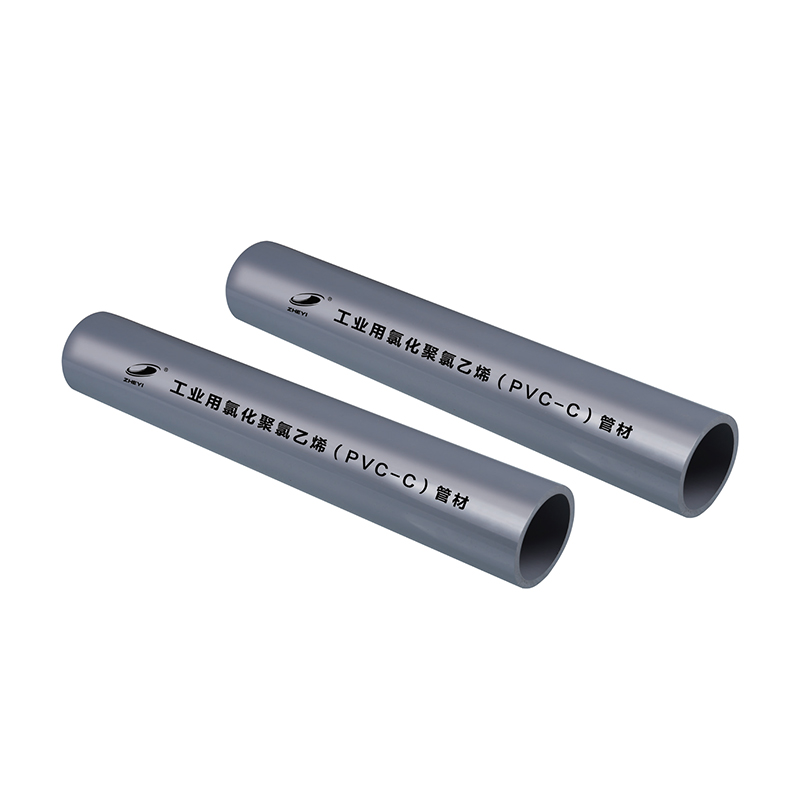
CPVC pipe for chemical industry applications is the thermoplastic piping standard where standard PVC fails — bridging the performance gap between low-cost plastic and expensive fluoropolymer or lined steel systems. Its chlorination-enhanced molecular structure delivers working temperatures up to 93 degrees Celsius, broad chemical resistance covering the majority of industrial process fluids, and a service life routinely exceeding 25 years in correctly specified installations.
93 °C Max working temperature
25+ yrs Service life in chemical plants
56–74% Chlorine content by weight
ASTM / ISO International certifications
Is CPVC Pipe Suitable for Chemical Industry Piping Systems?
CPVC pipe for chemical industry systems is a fully validated engineering choice for the transport of corrosive process fluids, chemical dosing lines, acid transfer headers, and effluent management networks. Chlorinated polyvinyl chloride (CPVC) is produced by post-chlorination of standard PVC resin, increasing the chlorine content from approximately 57% to between 63% and 74% by weight. This additional chlorination fundamentally alters the polymer's heat deflection temperature, tensile strength, and chemical attack resistance.
The result is a piping material that outperforms standard PVC across the critical performance axes that chemical industry installations demand:
- Temperature resistance extended from 60 degrees Celsius (PVC) to 93 degrees Celsius (CPVC) at rated working pressure
- Broader chemical compatibility covering concentrated acids, dilute alkalis, oxidising agents, and halogenated solvents that degrade standard PVC
- Higher pressure ratings at elevated temperatures — CPVC retains 50% of its ambient-temperature pressure rating at 82 degrees Celsius
- Lower installed cost than lined steel, PVDF, or PTFE-lined systems for the same service conditions
- Electrically non-conductive — no cathodic protection requirement, no galvanic corrosion risk in mixed-material installations
Engineering Definition
CPVC (Chlorinated Polyvinyl Chloride) pipe is a thermoplastic piping material produced by the free-radical chlorination of PVC resin, increasing the chlorine content to 63–74% by weight and raising the continuous service temperature ceiling from 60 °C to 93 °C while maintaining or improving resistance to a wide range of industrial chemicals.
What Chemicals Can CPVC Pipe Safely Handle in Industrial Applications?
CPVC pipe demonstrates rated compatibility with the majority of inorganic acids, oxidising agents, saline solutions, and bleach-based fluids encountered in chemical manufacturing, water treatment, and plating operations. The following table summarises key chemical compatibilities based on ASTM D543 immersion testing and industry field data:
| Chemical |
Concentration |
Temperature Limit |
Compatibility |
| Sulfuric acid (H2SO4) |
Up to 96% |
60 °C |
Excellent |
| Hydrochloric acid (HCl) |
Up to 37% |
60 °C |
Excellent |
| Nitric acid (HNO3) |
Up to 25% |
50 °C |
Good |
| Sodium hydroxide (NaOH) |
Up to 50% |
60 °C |
Good |
| Sodium hypochlorite (bleach) |
Up to 20% |
50 °C |
Excellent |
| Ferric chloride (FeCl3) |
Up to 40% |
60 °C |
Excellent |
| Phosphoric acid (H3PO4) |
Up to 85% |
60 °C |
Excellent |
| Concentrated aromatic solvents |
Any |
N/A |
Not recommended |
Aromatic and chlorinated organic solvents — including benzene, toluene, MEK, and methylene chloride — are not compatible with CPVC and require fluoropolymer alternatives such as PVDF or PTFE-lined pipe.
How Resistant Is CPVC Pipe to Acids and Alkalis in Chemical Plants?
CPVC pipe for chemical industry installations exhibits outstanding resistance to the broad spectrum of inorganic acids and moderate alkalis that constitute the majority of chemical plant process streams. The chlorinated polymer backbone is inherently unreactive to proton-donating acid species and hydroxide-based alkali solutions, providing a smooth, inert bore that neither corrodes, pits, nor releases metallic contamination into the process fluid.
Strong Resistance
- Dilute and concentrated hydrochloric acid across full industrial concentration range
- Sulfuric acid up to 96% concentration at temperatures below 60 degrees Celsius
- Phosphoric acid and polyphosphoric acid blends used in food-grade and industrial cleaning
- Sodium and potassium hydroxide solutions up to 50% concentration
- Chlorine and sodium hypochlorite solutions used in water treatment and bleaching operations
Known Limitations
- Concentrated nitric acid above 25% causes surface oxidation at elevated temperatures
- Fuming sulfuric acid (oleum) exceeds compatibility threshold at all concentrations
- Aromatic solvents cause swelling and delamination of the pipe wall structure
- Strong oxidising acids above 80 degrees Celsius require fluoropolymer alternatives
Can CPVC Piping Be Used for High-Temperature Chemical Transport?
CPVC pipe is the thermoplastic of choice for high-temperature chemical transport precisely because its glass transition temperature of approximately 106 degrees Celsius allows continuous service at 93 degrees Celsius — 33 degrees above the ceiling of standard PVC. This temperature advantage is the defining reason CPVC is specified over PVC in chemical plants operating hot acid rinse lines, heated reagent circuits, and steam-traced process headers.
Key high-temperature performance parameters for industrial specification:
- Continuous service temperature: 93 degrees Celsius at rated working pressure per ASTM F441
- Heat deflection temperature: 100 degrees Celsius at 1.82 MPa fibre stress per ASTM D648
- Pressure derating at 82 degrees Celsius: 50% of ambient-temperature rated working pressure must be applied
- Thermal expansion coefficient: 6.3 x 10⁻⁵ m/m/K — expansion loops or flexible couplings required on runs exceeding 6 metres in hot service
- Intermittent peak temperature: up to 100 degrees Celsius permissible for short-duration thermal excursions with significant pressure derating
CPVC Pipe vs PVC Pipe: Chemical Resistance Compared
The decision between CPVC pipe for chemical industry use and standard PVC pipe is determined entirely by three variables: operating temperature, chemical identity, and concentration. Below 60 degrees Celsius with compatible fluids, PVC performs adequately at lower cost. Above 60 degrees Celsius, or with fluids that attack standard PVC, CPVC is the mandatory specification upgrade.
| Property |
CPVC Pipe |
Standard PVC Pipe |
| Max continuous service temp. |
93 °C |
60 °C |
| Chlorine content |
63–74% |
~57% |
| Hot acid resistance |
Excellent |
Limited above 50 °C |
| Concentrated bleach |
Excellent |
Good (short term) |
| Oxidising agent resistance |
Good |
Moderate |
| Tensile strength at 23 °C |
55–60 MPa |
48–52 MPa |
| Relative installed cost |
1.5–2.0x PVC |
Baseline |
How Long Does CPVC Pipe Last in Chemical Industry Environments?
CPVC pipe for chemical industry installations delivers a verified service life of 25 to 50 years in correctly specified and installed systems, based on field performance data from chemical processing plants in North America and Europe where CPVC piping systems installed in the 1980s remain in active service. The longevity of CPVC depends on four primary factors: chemical compatibility, operating temperature relative to rated maximum, UV exposure management, and mechanical support adequacy.
- Chemical compatibility: operating within rated concentration and temperature limits eliminates the primary mechanism of CPVC degradation — the only exception is sustained exposure to incompatible organic solvents
- UV exposure: CPVC degrades under prolonged direct UV exposure without protective coating or insulation wrap — outdoor runs require UV-stabilised paint or lagging
- Support spacing: inadequate support allows sag and bending stress at elevated temperatures; CPVC requires supports at 900 mm to 1,200 mm centres in hot service versus 1,500 mm to 1,800 mm in ambient service
- Thermal cycling: repeated wide-range temperature cycling accelerates joint fatigue — cement-solvent welded joints outperform threaded connections in thermally cycled service
CPVC piping systems installed in semiconductor fabrication plants — among the most chemically aggressive industrial environments — routinely achieve 20 to 30 year service lives handling high-purity acids, bases, and oxidising agents with zero unplanned replacement, confirming the material's durability in real-world corrosive service.
Frequently Asked Questions
Does CPVC pipe require special jointing methods for chemical service?
Yes. Chemical-grade CPVC piping systems use solvent cement welding as the primary jointing method, producing a chemically fused joint with the same chemical resistance and pressure rating as the pipe itself. CPVC-specific solvent cement — not standard PVC cement — must be used; the two products have different formulations and are not interchangeable. Flanged connections using CPVC or PP flanges with full-face EPDM or PTFE gaskets are used at equipment connections and at points requiring future dismantling.
What pressure ratings does CPVC pipe carry in chemical applications?
CPVC pipe to ASTM F441 Schedule 80 carries working pressure ratings from 1,380 kPa (200 psi) for 50 mm diameter down to approximately 760 kPa (110 psi) for 150 mm diameter at 23 degrees Celsius. At the maximum chemical service temperature of 93 degrees Celsius, these ratings are derated to 25% of ambient values. Always apply the relevant temperature derating factor from the manufacturer's published pressure-temperature curve when sizing pipe for hot chemical service.
Is CPVC pipe approved for use in potable water and food processing as well as chemical plants?
Yes. CPVC pipe meeting NSF/ANSI 61 certification is approved for potable water contact in North America, and equivalent certifications exist for European and Australian markets. This dual approval — for both potable water and chemical service — makes CPVC a practical choice in food and beverage processing facilities where sanitary water supply lines and chemical cleaning-in-place (CIP) circuits must coexist within the same plant piping system.
Can CPVC pipe be used underground in chemical plants?
CPVC pipe is suitable for direct burial in chemical plant environments when installed with adequate bedding material, correct trench depth, and protection from point loading by stones or backfill debris. Unlike metallic pipe, it requires no cathodic protection and is immune to soil-side electrochemical corrosion. For aggressive soil conditions or installations beneath trafficked areas, CPVC pipe should be sleeved within a protective conduit or encased in lean concrete to prevent mechanical damage during backfill compaction.
 +86-15258772971
 dinys009@163.com

 English
 한국어
한국어 Español
 عربى
عربى