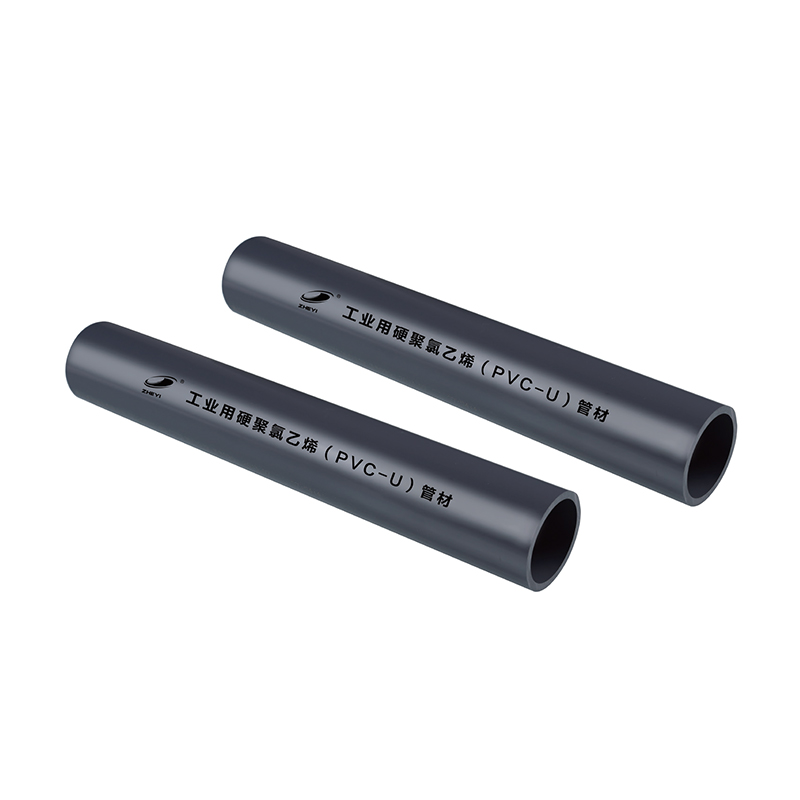
Every SCH 80 UPVC pipe that reaches a chemical plant or a water treatment facility has already passed through six controlled production stages and four rounds of testing. Manufacturers do not simply extrude a thicker wall and call it done: raw material selection, extrusion tooling, calibration, and pressure verification all determine whether a pipe survives decades of industrial service or fails within its first pressure cycle.
What Raw Materials Build a Pressure-Rated SCH 80 UPVC Pipe
A pressure-rated pipe starts with unplasticized polyvinyl chloride, or UPVC, a rigid resin that contains no plasticizers. That rigidity is what allows the material to hold a consistent pressure rating instead of stretching under load the way flexible PVC compounds do.
- UPVC resinProvides the base mechanical strength and chemical resistance of the finished pipe.
- Heat stabilizersProtect the compound from thermal degradation during high-temperature extrusion.
- Impact modifiersIncrease toughness so the pipe resists cracking under mechanical stress or impact.
- Lubricants and pigmentsImprove processing flow and add UV protection for outdoor installations.
Six-Stage Manufacturing Process Behind Every SCH 80 UPVC Pipe
SCH 80 UPVC pipe manufacturing follows a fixed sequence, and skipping or rushing any single stage shows up later as wall thickness variance or reduced burst pressure.
- CompoundingUPVC resin, stabilizers, and additives are blended into a uniform compound under controlled temperature and mixing speed.
- ExtrusionThe compound is melted and forced through a die engineered for SCH 80's thicker wall profile and tighter dimensional tolerance.
- Sizing and calibrationThe still-hot pipe passes through a calibration sleeve that fixes outer diameter, roundness, and wall thickness.
- CoolingControlled water cooling locks in dimensions and relieves internal stress before the pipe reaches the cutter.
- Cutting and end finishingPipes are cut to length, then chamfered, threaded, or socket-formed for fitting compatibility.
- Marking and packagingPipe size, pressure class, and standard information are printed before the pipe is packed for transport.
0.15in–0.34inTypical SCH 80 wall thickness across 1in–6in diameters
630 psiRated working pressure for 2in SCH 80 pipe at 73°F
140°FMaximum recommended continuous operating temperature
Rated Working Pressure: SCH 40 vs SCH 80 (psi at 73°F)
Quality Control Tests That Confirm SCH 80 UPVC Pipe Reliability
A finished pipe is only released to inventory after it clears dimensional, pressure, mechanical, and chemical testing.
| Dimensional inspection |
Verifies outer diameter, wall thickness, and roundness |
Every production batch |
| Hydrostatic pressure test |
Confirms pressure resistance and checks for leakage |
Sample lot testing |
| Impact resistance test |
Measures toughness against mechanical shock |
Sample lot testing |
| Chemical resistance test |
Evaluates performance against acids and alkalis |
Formulation qualification |
| Tensile strength test |
Confirms material strength meets specification |
Sample lot testing |
SCH 80 Wall Thickness by Pipe Diameter (inches)
SCH 80 UPVC pipe is a thick-wall, unplasticized PVC pipe engineered for higher pressure ratings than standard SCH 40 pipe, used wherever industrial fluid systems demand extra mechanical margin and chemical resistance.
Where Manufacturers Recommend Installing SCH 80 UPVC Pipe
Because manufacturing quality directly determines pressure margin and chemical resistance, properly produced SCH 80 UPVC pipe is specified across several demanding industrial settings.
Chemical Processing
Handles corrosive fluid transfer lines and processing equipment connections where acid or alkali exposure would degrade metal piping quickly.
Water Treatment
Runs filtration and wastewater circulation lines where a smooth internal bore reduces scaling and lowers long-term maintenance frequency.
Frequently Asked Questions
What makes SCH 80 UPVC pipe different from SCH 40?
SCH 80 pipe has a thicker wall at the same outer diameter, which raises its pressure rating and impact resistance compared with SCH 40 pipe of the same size.
What tests confirm SCH 80 UPVC pipe pressure ratings?
Hydrostatic pressure testing, dimensional inspection, and mechanical testing are performed on production samples before pipes are released for sale.
Where is SCH 80 UPVC pipe most commonly installed?
It is most common in chemical processing lines, water treatment facilities, factory utility piping, and high-pressure irrigation systems.
How long does SCH 80 UPVC pipe typically last?
Properly manufactured and installed SCH 80 UPVC pipe commonly delivers several decades of service life in non-abrasive industrial fluid applications.
 +86-15258772971
 dinys009@163.com
 English
 한국어
한국어 Español
 عربى
عربى