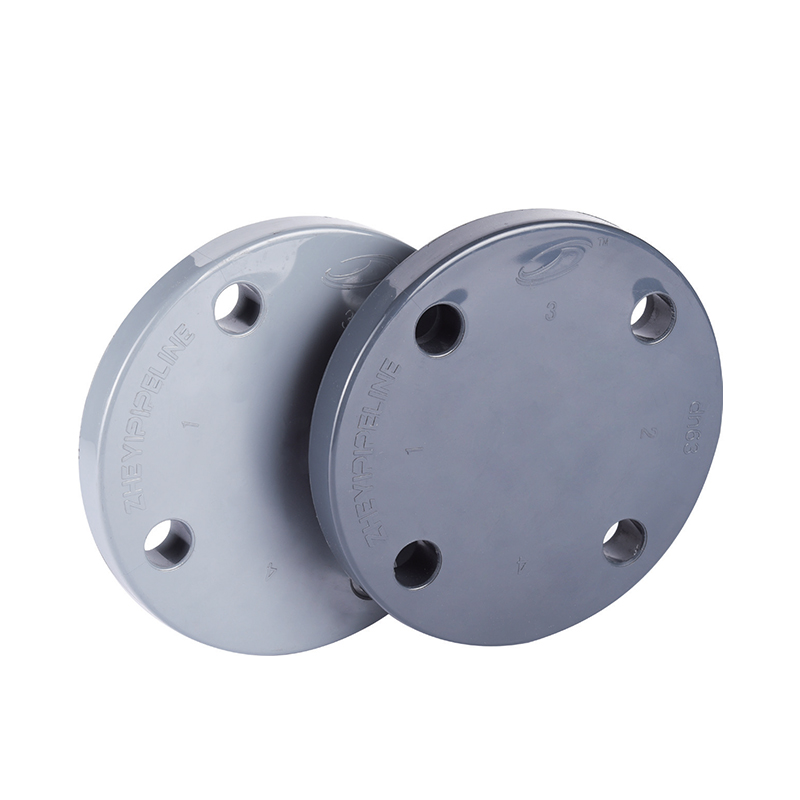
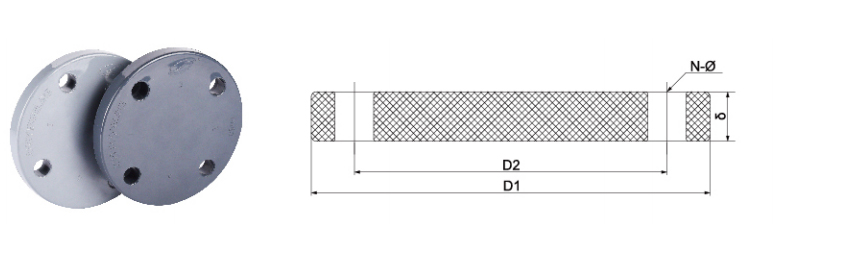
- Material Composition: Manufactured from SCH80 UPVC (Unplasticized Polyvinyl Chloride) and CPVC (Chlorinated Polyvinyl Chloride), ensuring resistance to a wide range of chemical media. This makes the blind flange suitable for applications where **chemical resistance** is paramount.
- Structural Integrity: Designed according to **DIN standards** to provide a robust and secure seal at the end of a pipeline. Its solid, disc-like structure is engineered to withstand pressures without leakage, which is crucial for **pipe system maintenance** and shutdown applications.
- Ease of Installation: Features a bolt pattern that aligns with standard pipe fittings, allowing for straightforward **UPVC/CPVC blind flange installation** and removal. This design simplifies pipeline modification and repair procedures, reducing downtime in industrial settings.
This blind flange is manufactured in compliance with **ASTM D1784** for material and **DIN 8063** for dimensions, ensuring compatibility and consistent performance. The product is designed to provide a secure and non-corrosive seal for isolating sections of piping systems. Its non-metallic construction prevents galvanic corrosion, a common issue in mixed-material systems, making it a reliable component for **industrial fluid handling** and **water treatment** applications. The inherent properties of UPVC and CPVC provide a lightweight alternative to metallic flanges, reducing the load on supporting structures.
Technical Specifications
| Parameter |
SCH80 UPVC Blind Flange |
SCH80 CPVC Blind Flange |
| Nominal Size |
DN 15 to DN 200 |
DN 15 to DN 200 |
| Standard |
DIN 8063 |
DIN 8063 |
| Material |
Unplasticized Polyvinyl Chloride |
Chlorinated Polyvinyl Chloride |
| Operating Temperature Range |
-10°C to +60°C |
0°C to +95°C |
| Maximum Operating Pressure |
1.0 MPa (150 PSI) |
1.0 MPa (150 PSI) |
Application Areas
This blind flange is specified for use in scenarios where **corrosion resistance** and a reliable seal are critical. Typical applications include:
- Chemical processing and transport systems.
- Water and wastewater treatment facilities.
- Semiconductor manufacturing plants.
- Power generation and cooling systems.
- Swimming pool and aquatic center plumbing.
FAQ
1. What are the key differences between a UPVC and CPVC blind flange, and how do I choose the correct one for my application?
The primary distinction lies in their **temperature resistance**. A **UPVC blind flange** is suitable for applications with a maximum operating temperature of up to 60°C, while a **CPVC blind flange** can handle media with temperatures up to 95°C. The choice depends entirely on the specific fluid temperature and operational environment of your system. For instance, processes involving hot corrosive liquids necessitate the higher thermal rating of CPVC. To ensure you select the optimal flange, please consult our technical specifications against your operational parameters. Our application engineers can provide a free consultation to analyze your specific requirements.
2. How does the pressure rating of an SCH80 non-metallic blind flange compare to its metallic counterpart, and can it handle industrial pressures?
While metallic flanges generally have higher pressure ratings, an **SCH80 non-metallic blind flange** is engineered to meet the pressure demands of many industrial fluid systems, typically up to 1.0 MPa (150 PSI) at standard temperatures. The pressure rating is a function of both material properties and temperature; as temperature increases, the pressure rating decreases. It is important to check the pressure-temperature derating charts for the specific material (UPVC or CPVC) and operational conditions. Our blind flanges are rigorously tested to ensure they maintain structural integrity and a leak-proof seal within their specified limits, providing a reliable, corrosion-free solution for your **high-pressure UPVC/CPVC piping needs**.
 +86-15258772971
 dinys009@163.com

 English
 한국어
한국어 Español
 عربى
عربى