When a piping contractor opens a box of CPVC elbows on a chemical plant job site and sees a few pieces with slightly dull surfaces or faint streaks, the cause is rarely the raw material. It is almost always the process that formed them. Injection molding is how virtually all CPVC fittings are manufactured today, because it is the only method that produces dense, dimensionally accurate parts with controlled wall thickness at industrial scale and acceptable cost. Yet CPVC is a chlorinated polymer with a narrow thermal processing window. The entire craft of molding a good fitting comes down to keeping the melt hot enough to fill the cavity completely while protecting it from the heat and shear that cause decomposition.
Why Injection Molding Is the Standard for CPVC Fittings
CPVC fittings connect the pipes in industrial fluid handling systems where corrosion resistance and elevated temperatures rule out metals and ordinary PVC. Chlorinating PVC raises the material’s heat distortion temperature and broadens its chemical resistance, but the added chlorine makes the polymer vulnerable to heat and shear during processing.
Injection molding solves the geometry problem. Fittings are short, complex parts—elbows, tees, reducers, unions—that must hold a consistent wall thickness to carry their rated pressure. Inside a closed mold, high injection pressure packs the melt into every corner of the cavity, forming a dense structure with repeatable dimensions. Extrusion, by contrast, efficiently produces the long continuous shapes used for the piping itself, such as these CPVC pressure pipes. For fittings, injection molding is the natural pairing: speed where possible, precision where required.
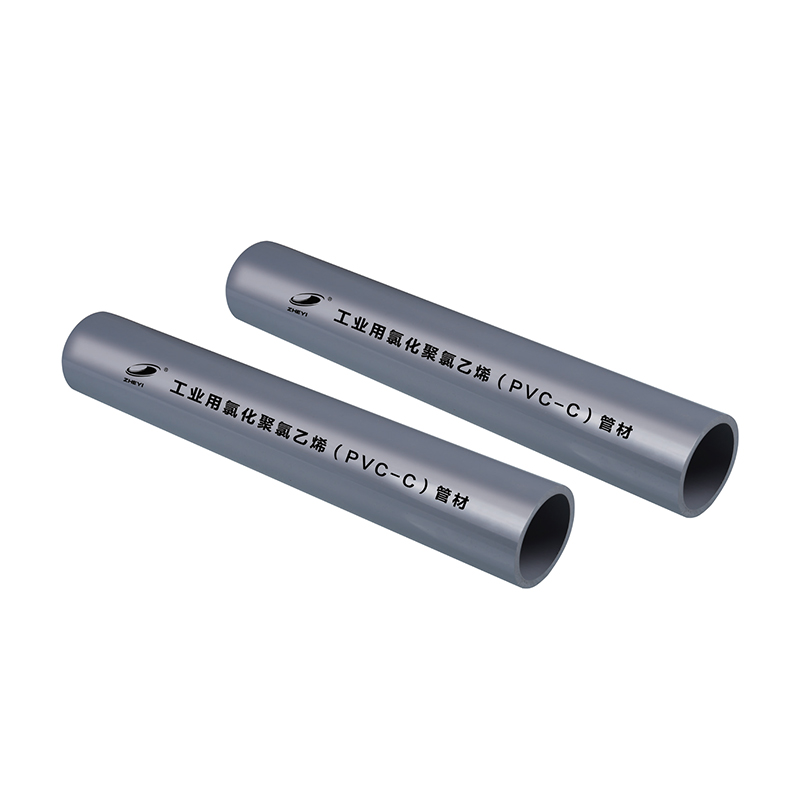 Custom CPVC Pipe pressure For Food Industry/Automotive/Electronic Suppliers, FacZheyi Pipeline (Wuhan) Co., Ltd. Is China Custom CPVC Pipe pressure For Food Industry/Automotive/Electronic Suppliers, Factory, Manufactu...View Product →
Raw Material Preparation: The Compound Sets the Limits
CPVC fittings begin life as a formulated compound, not as bare resin. The CPVC base is mixed with heat stabilizers to delay dehydrochlorination, lubricants to control friction against the screw and mold walls, impact modifiers to preserve toughness in the finished part, and pigments such as titanium dioxide for the familiar gray or orange finish.
Moisture is the first quality risk on the shop floor. CPVC pellets absorb humidity from the air, and when that moisture enters the heated barrel it flashes to steam, producing surface splay marks and internal voids. That is why most processors dry the compound before molding, typically at 70 to 85 °C for two to four hours, and confirm moisture content before starting a shift. This step is easy to overlook, but it is the most economical form of defect prevention available.
Machine Setup: Working Inside a Narrow Temperature Window
The Screw and Barrel
CPVC is molded on machines with a screw designed for rigid PVC compounds—typically a compression ratio of about 1.6:1 to 2.0:1. A screw designed for polyethylene generates too much shear heat and will degrade CPVC quickly. The barrel itself should have the lowest possible hang-up points so the melt does not linger and decompose.
Temperature and Residence Time
Temperature is managed zone by zone along the barrel, with the rear zone the coolest and the nozzle zone the hottest, generally in the range of 160 to 185 °C. The melt temperature at the nozzle should stay close to 170 to 185 °C. Pushing beyond roughly 200 °C, even for a short period, triggers dehydrochlorination: the part emerges discolored, the mold surface becomes fouled with corrosive residue, and the degradation accelerates once it starts.
Residence time matters just as much as temperature. If the shot size is small relative to barrel capacity, the compound lingers in the heated barrel and degrades cycle after cycle. Good process design keeps the shot volume high enough that material rotates through the barrel steadily.
Mold Design Considerations for CPVC Flow
Gates, Draft, and Venting
CPVC melt is viscous compared with olefins, so mold design must give the material an easier path. Gates are made larger than for an equivalent part in polypropylene or polyethylene, and wall sections avoid abrupt changes that would trap air or create thin, weak flow fronts. Draft angles of about 0.5 to 1 degree on vertical walls allow clean ejection without distorting the part, and vents are shallower than for most thermoplastics—typically 0.02 to 0.03 mm—so the small amount of gas CPVC emits can escape without flash.
Weld Line Placement
Weld lines separate a well-designed CPVC mold from a poor one. When melt flows around a core, the two fronts meet on the downstream side, and that seam is the weakest point in the part. Mold designers place the weld line where service stress is lowest and keep mold temperature in the 50 to 80 °C band so the fronts bond properly. In a standard CPVC 90-degree elbow, this placement is what prevents premature failure at the bend.
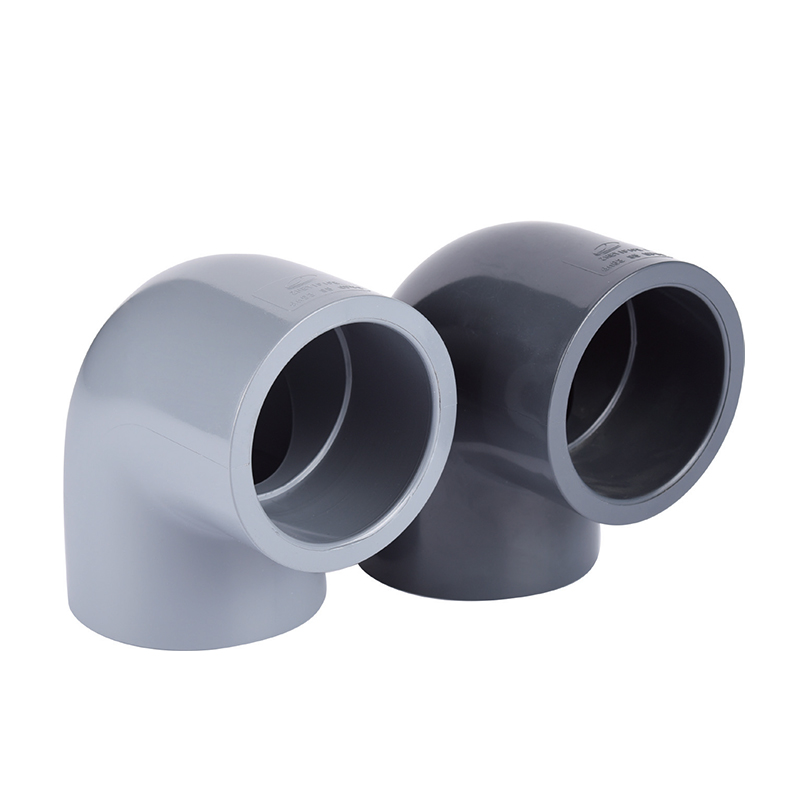 Custom SCH8O/DIN UPVC/CPVC 90° Elbow For Food Industry/Automotive/Electronic SupZheyi Pipeline (Wuhan) Co., Ltd. Is China Custom SCH8O/DIN UPVC/CPVC 90° Elbow For Food Industry/Automotive/Electronic Suppliers, Factory...View Product →
Key Process Parameters That Decide Fitting Quality
Four parameters control most of what determines whether a fitting passes inspection.
Typical injection molding process windows for CPVC fittings; exact values depend on the compound formulation and part geometry.
| Parameter |
Typical Range |
Effect on the Part |
| Melt temperature |
170–185°C |
Above this range CPVC degrades; below it, the mold does not fill cleanly. |
| Injection pressure |
600–1000 bar |
Drives complete cavity fill and dense packing. |
| Hold pressure |
400–800 bar |
Prevents sink marks and stabilizes final dimensions. |
| Back pressure |
5–20 bar |
Produces consistent dosing without overheating the melt. |
| Mold temperature |
50–80°C |
Strengthens weld lines and regulates the cooling rate. |
| Cooling time |
20–60 s depending on wall thickness |
Premature ejection causes warpage and residual stress. |
These numbers are starting points, not fixed recipes. A thick-walled Schedule 80 coupling needs longer hold and cooling phases than a thin-walled fitting, and a cold mold running a complex tee may need higher melt temperature to avoid short shots. The processor’s job is to document the validated window for each mold and stay inside it.
Common Quality Issues and How to Avoid Them
Frequent injection molding defects in CPVC fittings, their causes, and practical corrections.
| Issue |
Root Cause |
Prevention |
| Degradation (discoloration, streaks) |
Melt temperature or residence time too high |
Check the barrel profile, reduce interruptions, keep shot size matched to barrel capacity |
| Short shots |
Low injection pressure, cold melt, restricted gate |
Raise pressure and melt temperature, enlarge the gate |
| Weak weld lines |
Flow fronts cool before bonding |
Increase mold temperature, add venting, relocate the weld line |
| Sink marks and voids |
Low hold pressure, thick wall sections |
Extend hold time, raise hold pressure, review wall thickness |
| Flash |
Insufficient clamp force or damaged parting line |
Increase clamp tonnage, clean and rework the mold |
Post-Molding Operations and Quality Checks
Once a fitting is ejected, the cycle is not finished. Flash removal is usually brief because a maintained mold produces very little. Dimensional inspection follows: socket inner diameters, wall thickness, and face-to-face dimensions are checked against gauges machined for the relevant standard. Samples from each batch are pressure tested, and every part is visually screened for discoloration, voids, and gate blush.
The final dimensions determine how the fitting performs in the field. Socket depth and concentricity control how reliable a solvent cement joint will be, which is why installers should read our guide to CPVC fittings solvent cement cure time before pressuring a new line.
Standards, Pressure Ratings, and What to Ask a Supplier
Every injection molded CPVC fitting is machined to a dimensional standard: DIN in much of Europe and Asia, ANSI/ASME in North American projects. The mold cavity is cut to one system of socket depths, spigot sizes, and tolerances, and the two are not interchangeable without adapters. The first question a buyer should ask is therefore which standard the fittings conform to, and the second is the pressure class—usually expressed as Schedule 40 or Schedule 80.
Pressure ratings are not fixed values. CPVC loses strength as temperature rises, so a rating at 23 °C must be derated as the operating temperature climbs toward 90 °C. The derating curves that apply to pipe also apply to fittings, and our CPVC pipe pressure rating guide gives the calculation method useful for system design. DIN and ANSI also differ in connection methods—socket depths, thread forms, and flange interfaces all follow their own conventions; see our comparison of connection method requirements under DIN and ANSI for the details.
For a branched system, the geometry of the tee must match the pipeline exactly, whether you need an equal tee or a reducing tee. Confirm that CPVC tee fittings are dimensionally verified against the relevant standard, and ask whether the batch number can be traced back to molding records, wall-thickness measurements, and pressure test results.
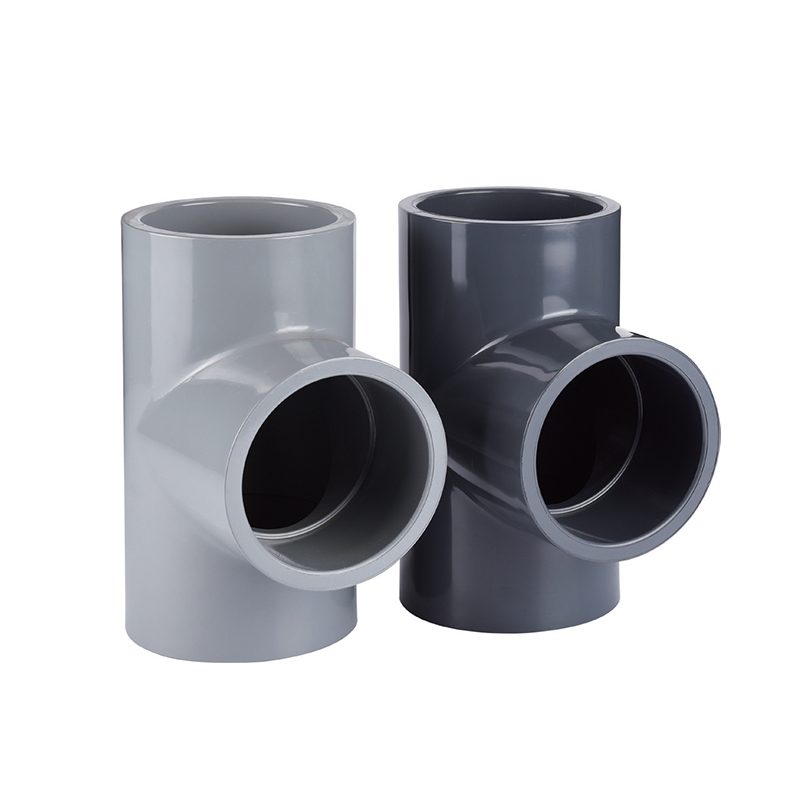 Custom SCH8O/DIN UPVC/CPVC Tee For Food Industry/Automotive/Electronic SuppliersZheyi Pipeline (Wuhan) Co., Ltd. Is China Custom SCH8O/DIN UPVC/CPVC Tee For Food Industry/Automotive/Electronic Suppliers, Factory, Manu...View Product →
The Process Behind Every Good CPVC Fitting
CPVC fittings look simple, but the process behind them has to respect the material’s chemistry at every stage: a balanced compound, dry pellets, a barrel profile that never crosses the degradation threshold, a mold designed for the flow behavior of chlorinated PVC, and process windows held under control. When all of this is managed well, injection molding produces fittings with consistent wall thickness, dense structure, and predictable pressure performance—exactly what an industrial piping system needs over decades of service.
For engineering and procurement teams, the practical takeaway is to evaluate process control, not just price. Which standard are the molds cut to? What is the wall-thickness tolerance? Are pressure tests traceable to batch records? A fitting is only as reliable as the process that made it, and the process is only as reliable as the data left behind to prove it.
 +86-15258772971
 dinys009@163.com
 English
 한국어
한국어 Español
 عربى
عربى