In a semiconductor fab, the piping network that carries ultrapure water and aggressive wet chemicals is not a passive utility. It is a direct extension of process quality. A pipe that releases trace iron or sheds microparticles can push particle counts past ITRS thresholds and quietly lower die yield. Published studies of ultrapure water distribution systems have also shown that some piping materials sustain bacterial growth such as Ralstonia, creating biofilm risks that require aggressive sanitization. Chlorinated polyvinyl chloride, widely known as CPVC, has become a standard choice for many of these lines because it balances purity contribution, chemical resistance, installation practicality, and installed cost.
A single uncontrollable metal contamination event can cost a fab an entire lot; piping material is one of the few upstream variables engineers can specify precisely.
Core Material Requirements for Semiconductor-Grade CPVC Piping
Semiconductor-grade CPVC selection depends on five measurable requirements, not on a general clean piping label.
Low leachables: the compound must release negligible metal ions and organic carbon into ultrapure water or process chemistry.
Smooth wetted surface: inner wall roughness must be controlled to reduce particle entrapment and biofilm formation.
Chemical resistance: the pipe must tolerate the specific wet chemicals used in etch, clean, and CMP steps, including HCl, H2SO4, H2O2, and IPA at the intended service temperature.
Predictable pressure de-rating: the allowable working pressure must be quantified at every temperature above ambient.
Joint reliability: solvent-cemented joints must deliver repeatable strength under thermal cycling.
93 °CMax continuous CPVC service temperature
Below 1 ppbTypical single-ion leachable target
Sch80Preferred schedule for pressure lines
15+ yearsDocumented industrial service life
Definition
Purity-rated semiconductor-grade CPVC is a compound formulated and tested so that the wetted surface releases negligible ions, organic carbon, and particles when exposed to ultrapure water and process chemicals.
Material Purity: Leachables and Particle Shedding
For a fab application, the piping material must keep the fluid cleaner than the chemistry requires; the pipe itself cannot become a contaminant source.
CPVC compounds contain stabilizers, lubricants, and pigments. In semiconductor service, these additives must be selected so that extractable metals such as iron, copper, zinc, and antimony stay below parts-per-billion levels. Total organic carbon release is equally important: after the initial system flush, a UPW loop should not gain measurable TOC from the pipe wall. Surface finish also controls particle adhesion. A rough bore gives microparticles a place to settle and bacteria a surface to colonize. For high-purity lines, the inside surface typically needs a roughness average of 0.8 μm or better.
Typical semiconductor-grade CPVC performance targets and verification methods.
Parameter
Typical requirement
Verification approach
Inner surface roughness (Ra)
0.8 μm or better
Surface profilometer
TOC leachables
Below 10 ppb in UPW loop
TOC analyzer
Single metal-ion leachables
Below 1 ppb
ICP-MS
Particle shedding
Validated by flush count
Liquid particle counter
Every CPVC batch destined for a semiconductor fab should ship with a certificate showing leachable metal and TOC results from the extruded pipe, not just from the base compound.
Chemical Compatibility and Temperature Limits
CPVC resists most inorganic acids, alkalis, and many organic solvents at working temperatures up to 60 °C, which covers the majority of wet-bench and CMP chemical delivery applications.
The compatibility review starts with the exact chemistry: hydrochloric acid, sulfuric acid, nitric acid, ammonium hydroxide, and hydrogen peroxide appear regularly in front-end processes. CPVC handles these at the concentrations and temperatures found in typical wet stations. The added chlorine in CPVC raises the heat distortion point to roughly 93 °C continuous, giving a wider safety margin than unplasticized PVC. But the allowable pressure falls as temperature climbs. A 1-inch Schedule 80 CPVC pipe rated near 370 psi at 23 °C can drop to about 160 psi at 82 °C under the same standard. That relationship is why every semiconductor CPVC line should be specified with an explicit design temperature and a clear CPVC pressure-rating calculation. For the temperature picture across competing polymers:
Skipping temperature de-rating is a leading cause of early CPVC line failure. From 23 °C to 80 °C, the allowable working pressure of Sch80 CPVC can fall by more than half; design the line for its hottest operating case, not the average.
CPVC vs. PVDF vs. PFA for Wet Process Piping
Neither PVDF nor PFA is automatically better than CPVC; the right selection depends on temperature, chemistry, and total system cost.
PVDF offers higher heat resistance and very low leachables, but the material cost is roughly two to three times that of CPVC, and large-bore butt-fusion welding requires more specialized labor. PFA provides the highest purity and thermal capability, yet the installed cost and joining skill requirements are the highest of the three. CPVC, joined with solvent cement, installs quickly, has decades of service data in chemical handling, and is well understood by plant maintenance teams. For most wet-bench chemical lines that stay below 80 °C, CPVC remains the engineering-economic optimum.
Material comparison for semiconductor wet-chemical and UPW piping.
Material
Max continuous temp
Relative material cost
Joining method
Typical service
CPVC
93 °C
1x baseline
Solvent cement
Chemical lines, UPW pretreatment
PVDF
120 °C
2.5-3x
Butt fusion
Hot corrosive chemical lines
PFA
180 °C
4-5x
Fusion welding
High-purity, hot chemical lines
Selection rule: use CPVC when maximum fluid temperature stays below 80 °C and the chemistry is compatible; move to PVDF or PFA only when process temperature or purity requirements exceed the CPVC envelope.
Standards, Schedules, and Specification Practices
A semiconductor CPVC pipe specification must reference recognized dimensional and material standards and demand batch evidence from the manufacturer.
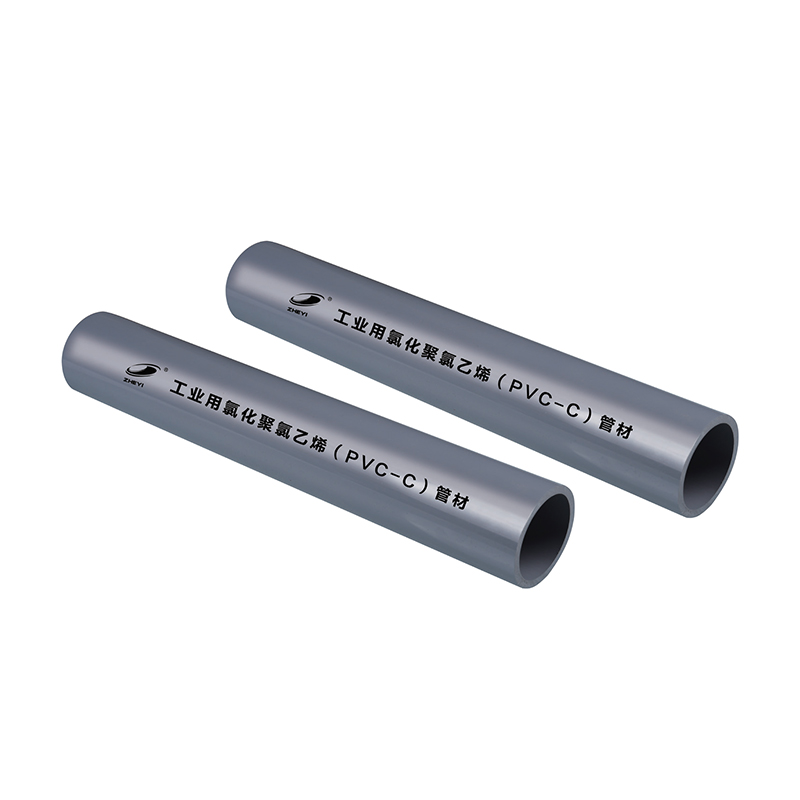
Start with the compound standard: ASTM D1784 defines the cell-class requirements for CPVC materials, covering impact strength, hydrostatic strength, and heat distortion. Pipe dimensions and pressure ratings are set by ASTM F441/F441M; fittings and socket dimensions are specified in ASTM D2846. In many international fab projects the piping system must also fit DIN or ANSI flanged interfaces, so the flange drilling, face type, and bolt circle must match the mating valves and equipment. Specifying Schedule 80 wall thickness gives a broader pressure margin at elevated temperatures and better mechanical stability in long vertical runs. ZHEYI Group, an industrial pipe system manufacturer operating since 2007, supplies CPVC pressure pipes that can be specified to DIN or ANSI requirements, with batch documentation available for fab projects.
Specify the pipe by a named standard, schedule, and end connection type, and require the test certificate at delivery. A fab cannot speed up wafer qualification by accepting pipe without leachables data, TOC data, and an accurate material certificate.
Documented batch quality is non-negotiable: the certificate of analysis is the only way to confirm that the delivered CPVC pipe matches the purity assumptions used in the wet-process design.
Installation Practices That Preserve Piping Performance
A well-specified CPVC system still fails early if joints are rushed, supports are spaced like steel, or the line is pressure-tested without temperature compensation.
The installation sequence below follows the logic that has worked in hundreds of industrial CPVC lines:
Apply solvent cement correctly. Use a clean primer and the correct body cement for the pipe size, and let the joint cure fully before pressure is applied; cure time depends on ambient temperature and diameter.
Provide close support spacing. CPVC is a thermoplastic and sags under its own weight at high temperature; follow the manufacturer support tables instead of steel pipe spacing.
Design for thermal expansion. Longer runs need expansion loops or offset bends; anchored, fixed points create stress that solvent joints cannot absorb.
Flush and verify before start-up. Run a low-pressure water flush followed by a hot deionized water flush, then check particle count and pressure hold to validate the installed system.
Good to know
CPVC coefficient of thermal expansion is roughly five times that of carbon steel. A 30-meter straight run with a 30 °C temperature swing can move several centimeters if the layout has no expansion compensation.
Frequently Asked Questions
What is the maximum temperature for CPVC pipe in semiconductor chemical lines?
CPVC can operate continuously at up to 93 °C, but the allowable pressure must be de-rated above 23 °C. Most designers keep CPVC chemical lines below 80 °C for a comfortable safety margin.
Is CPVC pure enough for ultrapure water distribution?
Semiconductor-grade CPVC with verified low leachables is used in UPW pretreatment and non-critical UPW loops. For the most demanding analytical and production loops, PFA or PVDF with fusion joints is still preferred where extremely low TOC and particle counts are mandatory.
How long does CPVC pipe last in a fab environment?
With correct material selection, de-rated pressure design, and proper installation, industrial CPVC lines commonly provide 15 to 20 years of service in wet chemical and water applications.
Does CPVC need to be replaced with PFA-lined pipe for hot acids?
Only when the combination of temperature and acid concentration exceeds the CPVC rated envelope. At 60 to 80 °C and typical wet-bench concentrations, CPVC remains chemically effective and far more economical than PFA-lined alternatives.
When in doubt, ask the pipe supplier for the de-rated pressure table and leachables certificate before approving CPVC for semiconductor service.
Selecting CPVC for semiconductor piping is a specification discipline: set purity limits, verify chemistry and temperature, apply pressure de-rating, and enforce installation procedures. When these material requirements are met consistently, CPVC stays one of the most cost-effective and reliable nonmetallic piping options in electronic manufacturing.
 +86-15258772971
 dinys009@163.com
 English
 한국어
 Español
 عربى