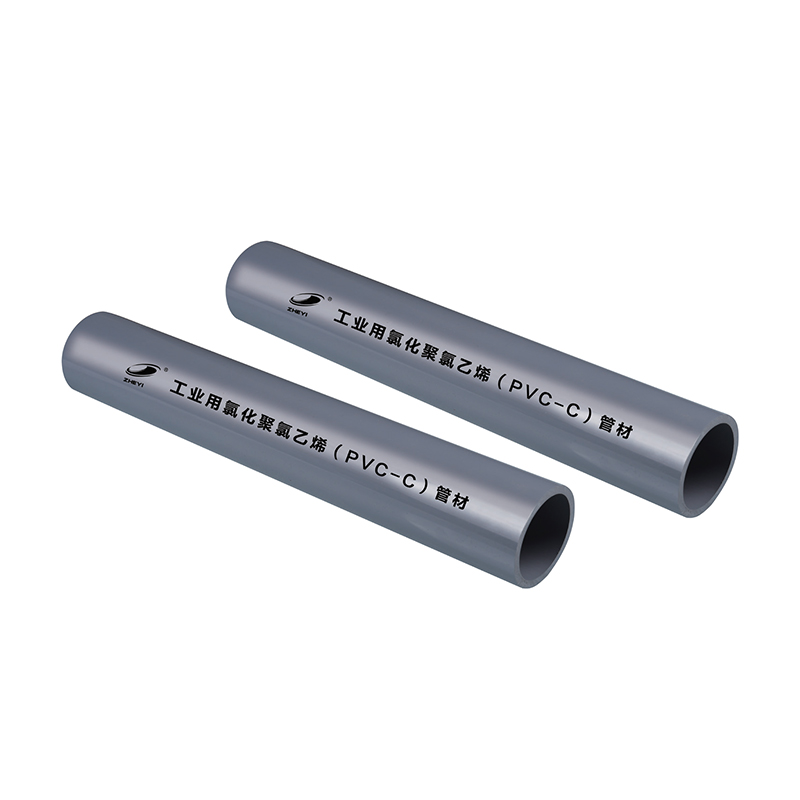
A purified water loop drawn in CPVC looks simple on the piping drawing and becomes difficult the moment the validation file is opened. The pipe has to satisfy a compound standard, a dimensional standard, a health-effects listing, a hygienic layout rule set and a pressure rating that is only true at 23 degrees Celsius. Facilities that treat CPVC as a commodity item find the gap at the factory acceptance test rather than at design review.
This guide covers what a pharmaceutical facility actually has to specify: the standards that must appear on the supplier paperwork, the temperature ceiling that rules CPVC out of some loops entirely, the layout numbers a hygienic review will check, the joining risks solvent cement brings into a clean space, and the documents to demand before a delivery is accepted.
23447 ASTM D1784 cell class typical of CPVC pressure compounds
L/D 2 Maximum dead-leg ratio in hygienic service under ASME BPE
1.5x Hydrotest pressure relative to design pressure, ASME B31.3
150 Hazen-Williams C factor for a smooth CPVC bore
The Standards That Define a Pharmaceutical CPVC System
A pharmaceutical CPVC system is defined by five standards and two certifications: ASTM D1784 for the compound, ASTM F441 for pipe, ASTM F439 for Schedule 80 fittings, ASTM F493 for solvent cement, ASME B31.3 Chapter VII for design, plus NSF/ANSI 14 and NSF/ANSI 61 certification for the finished components.
Compound identity comes first
CPVC pressure compounds are bought by ASTM D1784 cell class, typically 23447, which fixes minimum impact strength, tensile strength and heat deflection temperature for the resin. A quotation that offers CPVC without a cell class has not specified a material at all. Two compounds meeting the same nominal description can behave very differently at low temperature, and low temperature impact is what decides whether a fitting survives a winter delivery or a drop on site.
Pipe, fittings and cement are separate documents
ASTM F441 covers CPVC pressure pipe in Schedule 40 and Schedule 80, while ASTM F439 covers Schedule 80 fittings. Pharmaceutical work between DN 15 and DN 100 is normally specified in Schedule 80 even where the pressure calculation would allow Schedule 40, because the heavier wall brings impact resistance and a wider cement bonding surface. The trade-off is measurable: a DN 50 Schedule 80 fitting has roughly 3 mm less internal diameter than its Schedule 40 equivalent, which changes both pressure drop and the volume retained in every dead leg downstream.
Documentation expected for a pharmaceutical CPVC piping package, mapped to the standard that governs each item.
| Requirement |
Reference |
Evidence to request |
| Compound identity |
ASTM D1784, cell class 23447 |
Mill certificate stating resin cell class and lot |
| Pipe dimensions and pressure |
ASTM F441, Schedules 40 and 80 |
Wall thickness, outside diameter and burst reports per lot |
| Fittings |
ASTM F439, Schedule 80 |
Lot traceability and dimensional report |
| Solvent cement |
ASTM F493 |
Batch number, manufacture date and shelf life |
| Health effects |
NSF/ANSI 61 and NSF/ANSI 372 |
Certificate naming the exact product and size |
| Plastic material safety |
USP <661.1> and USP <88> Class VI |
Biological reactivity report on the finished compound |
Two documents deserve extra scrutiny. NSF/ANSI 61 certification is product and size specific, so a certificate for one diameter does not cover a fitting produced on a different tool; the certificate must name what is actually being shipped. USP <661.1> is written for drug packaging rather than for piping, and extending it to a pipe system is a facility decision. That decision is defensible, but the qualification rationale should state it plainly instead of implying the standard covers piping directly.
Where CPVC Stops: Temperature, Pressure and Sanitisation
CPVC pressure piping carries its published rating at 23 degrees Celsius and a practical ceiling near 93 degrees Celsius, with allowable pressure falling steeply in between; that ceiling, not the chemical resistance chart, is what rules CPVC out of water-for-injection loops.
ASTM F441 publishes temperature derating factors for both schedules, and the design pressure of a line is the rating at the highest temperature it will reach, not the number printed on the pipe. A line circulating at 60 degrees Celsius cannot be sized on the ambient figure: a Schedule 80 line with a comfortable margin at 23 degrees Celsius can sit outside its rating at 60 degrees, and the support spacing that was correct at installation is wrong at operating temperature as well.
Sanitisation decides more projects than corrosion does. Water for injection is commonly circulated hot and sanitised with steam at 121 degrees Celsius, a condition outside CPVC entirely; even an 80 degrees Celsius loop leaves a small fraction of the ambient rating plus a thermal movement problem. CPVC belongs on the utility side of the process, on purified water at ambient temperature, clean-in-place chemical distribution, cooling water, brine, waste neutralisation and laboratory drainage.
The rating printed on a CPVC pipe is a reference point measured at 23 degrees Celsius. The rating of the installed system is whatever the derating table and the support layout allow at the highest temperature that line will ever see.
CPVC fits when
- Purified water distribution runs at 20 to 30 degrees Celsius
- Caustic and acid clean-in-place lines stay at moderate temperature
- Cooling water, chilled water and brine need corrosion immunity
- Waste neutralisation and laboratory drainage carry mixed chemistry
- Installation speed and joint cost drive the project schedule
Specify alloy or lined steel when
- The loop is steam sanitised at 121 degrees Celsius
- Product streams contain ketones, esters or chlorinated solvents
- Design pressure exceeds the Schedule 80 rating at duty temperature
- Validated extractables data already exists for an alloy
- The route passes through a fire-rated compartment
Thermal movement is the second engineering constraint and the one most often skipped. CPVC expands by roughly 0.06 mm per metre for every degree Celsius of temperature rise, about five times the rate of carbon steel. A worked example makes the consequence concrete: a 30 m straight run warming from 20 to 60 degrees Celsius grows by approximately 73 mm. That movement must be taken up by a guided expansion loop or an offset leg, because clamping the run rigid pushes the load into solvent-cement joints, and joint failure is how CPVC systems normally fail. Support spacing must come from the pipe manufacturer's span table at operating temperature rather than from a steel table, and CPVC pipe supports should be rated for the same temperature as the pipe, with sliding guides wherever movement is expected.
Hygienic Layout: Dead Legs, Slope and Cleaning Velocity
Three layout numbers decide whether a CPVC pharmaceutical line passes hygienic review: a dead-leg ratio of 2 or less, a drain slope of 1/4 inch per foot on gravity lines up to DN 65, and a circulation velocity that keeps the loop turbulent during cleaning.
Dead leg (L/D): the length of an unused branch measured from the inside wall of the main pipe to the closed end, divided by the internal diameter of the branch. ASME BPE sets the hygienic limit at L/D of 2 or less, so a DN 25 branch has a maximum dead length of roughly 50 mm from the main wall.
Gravity drainage is governed by slope and support rather than by the material. A fall of 1/4 inch per foot, about 2 percent, is the usual minimum for lines up to DN 65, and the run must fall continuously to a low-point drain with no sag between hangers. CPVC sags more than metal at the same span and softens as temperature rises, so the support layout has to be checked for the operating condition, not the installation condition.
In a circulating purified water loop the target is turbulent flow, generally in the region of 1 to 2 m per second. In CPVC the limit is not erosion, because the bore is smooth with a Hazen-Williams C factor near 150, but hydraulic shock: a pressure wave in a thermoplastic line travels as a stress wave and can split a fitting at a fast valve closure. Slow-closing actuators and surge protection cost far less than a joint failure above a cleanroom ceiling.
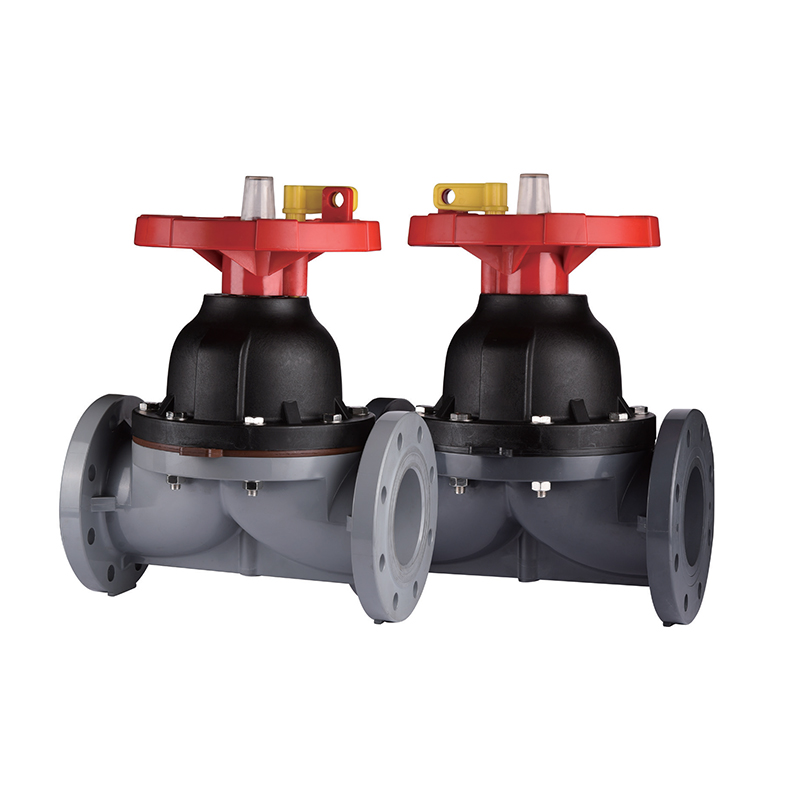
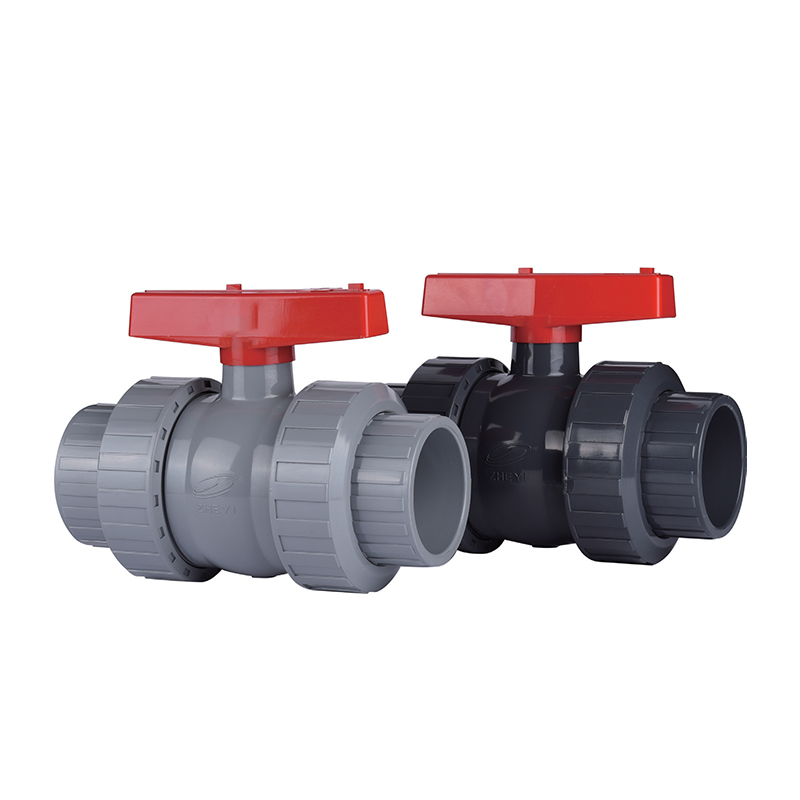
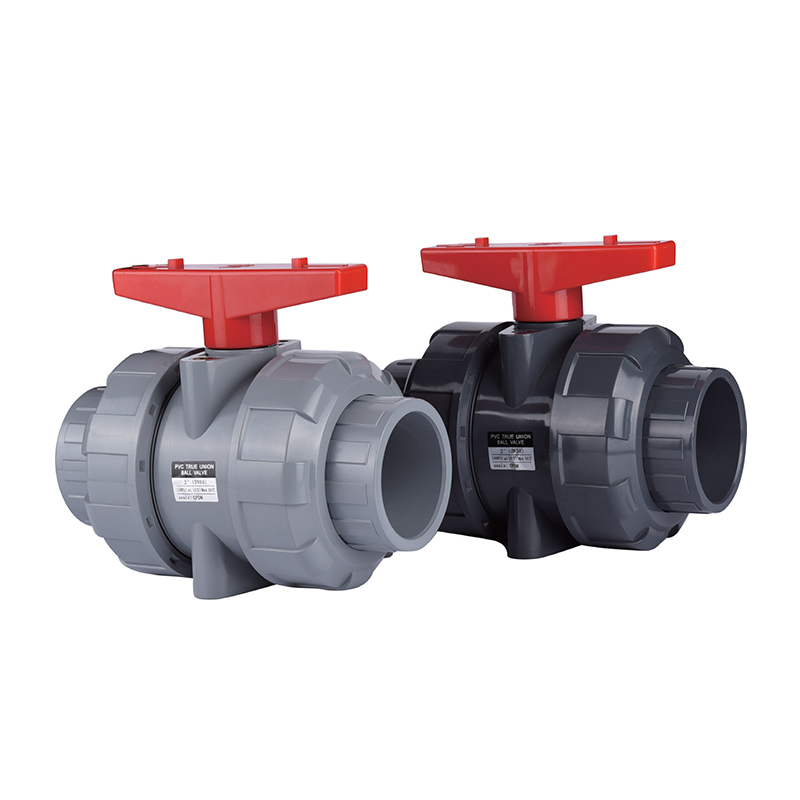
Valve selection follows the same logic. A ball valve leaves a cavity between ball and seat that holds product and cannot be flushed reliably, so product-contact isolation is normally a diaphragm valve, with ball valves reserved for utilities, cooling water and waste. Where a diaphragm valve sits on a short branch, the branch itself has to meet the L/D limit, and a union pattern lets the diaphragm be replaced without cutting pipe. Threaded joints should not appear in product-contact lines at all, because the thread root is a crevice that no flush reaches.
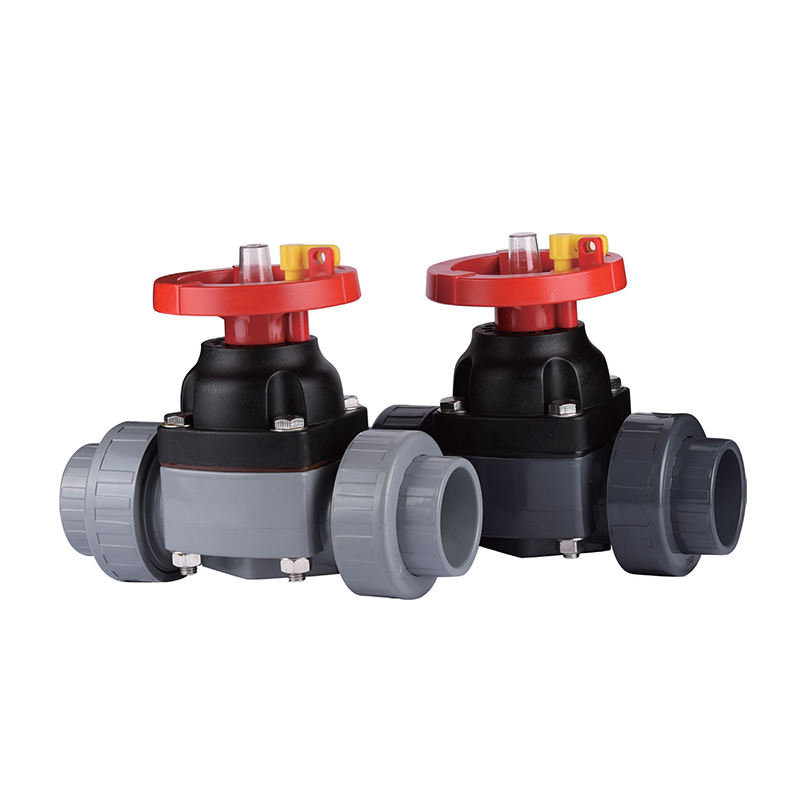 UPVC/CPVC Union Diaphragm Valve for Product-Contact IsolationUnion-style diaphragm valve in UPVC/CPVC, sized DN15–DN50, for product-contact isolation where diaphragm replacement without pipe cutting supports hygienic maintenance.View Product →
Joining and Chemical Compatibility Risks in a Clean Space
Solvent-cemented joints are the largest process risk in a pharmaceutical CPVC installation: every joint leaves an internal bead that can trap product and shed particles, and every joint needs its full ASTM F493 cure before hydrotest.
Cure time scales with diameter and shortens as ambient temperature rises, and the schedule issued with the cement governs. Testing a DN 100 joint a few hours after assembly because the site programme is tight is how leaks appear at commissioning instead of at handover, and the size and temperature matrix in this CPVC solvent cement cure time guide is the reference to hold a contractor to. Cementing also releases solvent vapour, so prefabrication outside the clean zone, followed by flushing and drying before connection, is standard practice in a facility with a validated environment.
Chemical compatibility is where cleaning agents catch people out. CPVC handles mineral acids, alkalis, salts and many aqueous solutions, but it is not suitable for aromatic hydrocarbons, ketones, chlorinated solvents and some esters and amines. Sanitants are the usual gap: a dilute peracetic acid solution at 20 degrees Celsius and the same solution at 60 degrees Celsius are different questions, and a chart entry measured at 23 degrees Celsius over 24 hours does not cover a recirculating clean-in-place cycle at 60 degrees Celsius. Each cleaning and sanitising agent must be checked against the resin supplier's data at the real concentration, temperature and contact time.
Do not substitute the chartPeracetic acid, sodium hypochlorite and isopropyl alcohol all appear on pharmaceutical cleaning schedules. Each has a concentration and a temperature at which CPVC is acceptable and a point beyond which it is not. A generic acid resistance table is not a substitute for the resin supplier's compatibility data at the actual duty.
Gaskets belong in the same conversation. EPDM is the default for water and dilute chemicals, while PTFE or PTFE-faced gaskets are specified where solvent resistance or extractables control requires them. Write the gasket specification into the order, since it is the first item quietly substituted when a supplier runs short.
What to Put in the Specification and the Purchase Order
A pharmaceutical CPVC order should carry seven documented items, all of which must be available before shipment; a supplier that cannot produce them is not qualified for this duty.
- Compound identity. ASTM D1784 cell class on the mill certificate, with the resin lot traceable to each pipe lot shipped.
- Test reports. Wall thickness, outside diameter and burst results per ASTM F441 and F439 sampling, not a single type test from an earlier year.
- Certification. Current NSF/ANSI 14 and NSF/ANSI 61 certificates naming the exact product and size being shipped.
- Pharmaceutical contact data. USP <661.1> and USP <88> Class VI reports on the finished compound from an accredited laboratory.
- Design calculation. Wall schedule and support spacing justified at maximum operating temperature under ASME B31.3 Chapter VII.
- Joining control. Cement batch, manufacture date and shelf life, plus the cure schedule the contractor will follow on site.
- Test and commissioning record. Hydrotest at 1.5 times design pressure, the quality of the test water, and the flush and dry-down record before release to the process.
Two clauses belong in the contract rather than in the data pack. The first is a substitution rule: an alternative compound, gasket or valve pattern requires written approval supported by the same documentation, because most substitutions become invisible once the line is insulated or the ceiling is closed. The second is a minimum wall thickness acceptance limit, since wall thickness is what the pressure rating actually depends on and it is the first value that drifts in a low-cost shipment.
Commissioning follows the same discipline. Flush to a defined water quality, dry to a defined dew point where the line serves a non-aqueous process, and take the first conductivity and microbial samples before the loop is released. A CPVC system that is correctly specified and correctly supported behaves predictably for decades; the failures that do occur trace back to an unverified compound, an unmanaged cure or a support layout designed at the wrong temperature.
Direct Answers for Specifiers and Buyers
Is CPVC acceptable for purified water systems?
Yes, for ambient-temperature purified water distribution. The pipe must carry an ASTM D1784 cell class such as 23447, hold current NSF/ANSI 61 certification for the exact size, and be installed to the dead-leg and slope limits set by ASME BPE and the applicable plumbing code. It is not acceptable for a water-for-injection loop sanitised at 121 degrees Celsius.
What is the maximum temperature for pharmaceutical CPVC piping?
The practical ceiling is about 93 degrees Celsius, and pressure must be derated per ASTM F441 long before that point. A line running at 60 degrees Celsius has to be designed, supported and hydrotested at 60 degrees Celsius, because the ambient 23 degrees Celsius rating does not describe the installed system.
Does solvent-cemented CPVC create a crevice problem in hygienic service?
Yes. Each cemented joint forms an internal bead that can retain product and release particles, so hygienic layouts minimise joint count, prefabricate outside the clean zone and use flanged or unioned connections at equipment. Where a joint cannot be avoided, cement quantity is controlled and the bead is inspected before the line is closed up.
Which documents should arrive with a CPVC pipe delivery?
Four documents: the mill certificate with the ASTM D1784 cell class and lot number, dimensional and burst test reports per ASTM F441, an NSF/ANSI 61 certificate naming the exact product and size, and a USP <88> Class VI report on the finished compound. If any one of them is missing, the delivery cannot support a pharmaceutical qualification file.
 +86-15258772971
 dinys009@163.com

 English
 한국어
 Español
 عربى