Threaded or Socket: Two Ways to Join Schedule 80 CPVC
The question usually surfaces after the pipe spec is already set. A plant engineer or maintenance supervisor selects Schedule 80 CPVC for its chemical resistance and higher pressure capability, and then has to decide how every fitting connects to the line. The short answer is that socket joints, fused with solvent cement, are the stronger and more leak-resistant choice for permanent pressure-carrying runs. Threaded joints, cut with NPT threads and sealed with tape or sealant, are justified where you need disassembly, equipment hookups, or a transition into metal-threaded components.
The mistake is to choose by habit instead of function. Threading every fitting for field convenience creates dozens of potential leak paths and lowers the pressure capacity of each joint. Solvent-cementing every joint without planning for future access turns a simple pump replacement into a cutting job. Most well-designed CPVC systems use both, with each joint type placed where it performs best.
What Schedule 80 CPVC Actually Gives You
Schedule 80 is a wall-thickness series. A Schedule 80 CPVC pipe has a thicker wall than Schedule 40 at the same nominal size, which raises the pressure rating and adds mechanical strength for loads and elevated temperatures. As a reference point, a 3/4-inch Schedule 80 CPVC pipe is rated at roughly 690 psi at 73°F. At 180°F the same pipe retains only about one-third of that rating, so the temperature-corrected number is usually the one you should design against.
The fittings have to keep pace with that rating. Schedule 80 CPVC fittings are produced to ASTM F439, with socket depths and wall thicknesses matched to the pipe. The practical differences between Schedule 40 and Schedule 80 pressure ratings matter most at the joint, because a fitting is never stronger than the pipe it connects.
Buying Schedule 80 CPVC pressure pipes and companion fittings from one manufacturer removes a common source of field failures: mismatched socket fit and thread geometry.
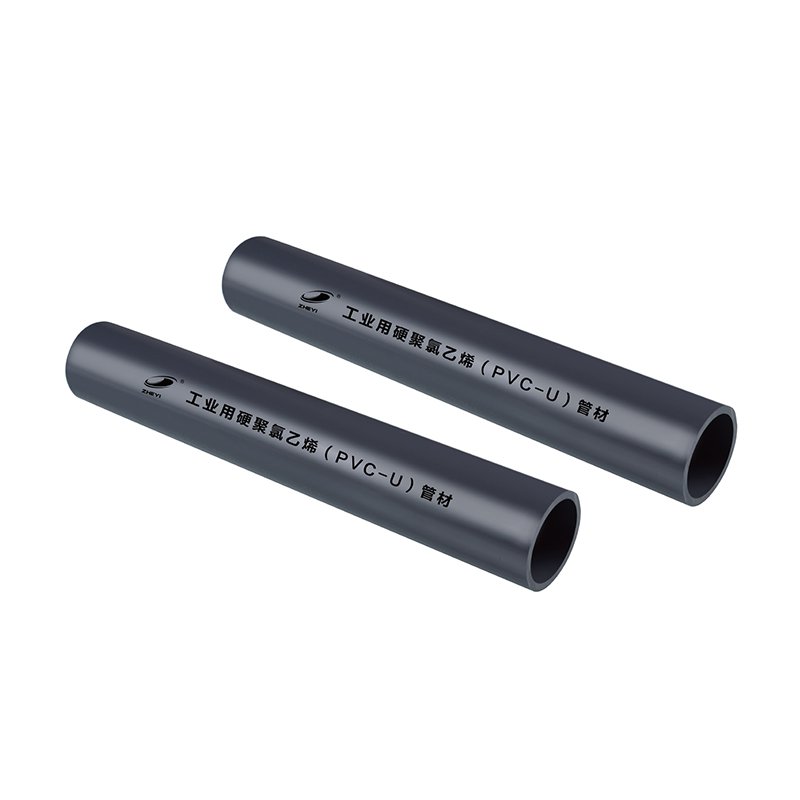
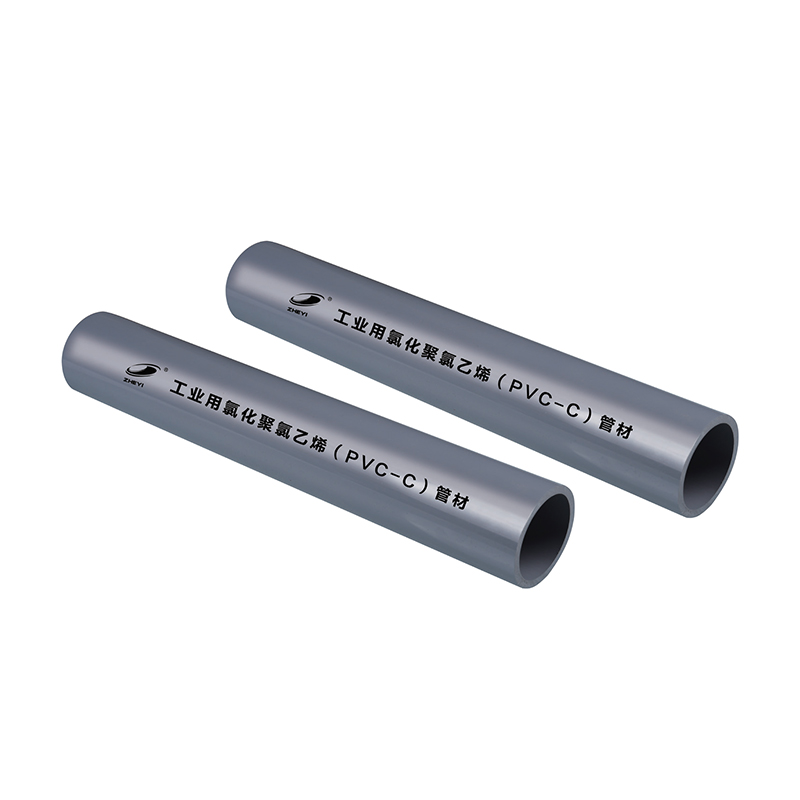 Custom CPVC Pipe pressure For Food Industry/Automotive/Electronic Suppliers, FacZheyi Pipeline (Wuhan) Co., Ltd. Is China Custom CPVC Pipe pressure For Food Industry/Automotive/Electronic Suppliers, Factory, Manufactu...View Product →
Socket Joints: The Strongest Way to Make a Permanent Connection
How socket fusion works
A socket fitting has an internal recess sized to accept the pipe end. The installer applies CPVC-rated solvent cement to the pipe and the socket, seats the pipe fully in the socket, and holds the assembly until the cement sets. The solvent softens both surfaces, allowing them to fuse into what becomes essentially one piece of material. There are no threads to cut into the wall and no hollow spaces where liquid can settle.
Because a correctly made socket joint is at least as strong as the pipe wall, pressure failures in solvent-welded systems normally appear in the pipe body, not at the joint. That is the behavior you want from a long run carrying hot acid, caustic, or chlorinated process water.
Where socket joints prove their value
Socket joints handle pressure surges and thermal cycling better than threaded joints because the load spreads over the full bonded area. The internal bore stays smooth and free of crevices, which reduces deposit buildup and simplifies flushing. For buried lines, enclosed chases, and long straight runs, socket is the default choice.
The trade-off is permanence. A solvent-cemented socket joint can only be removed by cutting the pipe. Every field assembly demands the right CPVC solvent-cement cure time, clean dry surfaces, and patience before pressure testing. Skipping the cure is the most common reason a supposedly strong joint leaks on startup.
Threaded Joints: Convenient Access, Lower Pressure Capacity
How NPT threads change the mechanics
Threaded Schedule 80 CPVC fittings use tapered NPT threads conforming to ANSI B1.20.1. The installer wraps the male thread with PTFE tape or applies a sealant made for plastics, then tightens the fitting hand-tight plus a fraction of a turn. The taper deforms slightly during assembly to close the spiral leak path.
The critical limitation is material loss. Cutting threads removes part of the wall between the thread root and the fitting exterior, leaving a thinner section than the nominal Schedule 80 wall. The thread root also acts as a stress riser. In practice, a threaded CPVC joint carries substantially less pressure than a socket joint of the same nominal size, particularly in small diameters where wall thickness is already tight.
Where threaded joints still earn their place
Threaded connections belong at equipment interfaces: pump flanges, tank nozzles, pressure gauges, filter housings, and skid modules. These components are routinely disconnected for service, and threads allow that without cutting the line. Threaded joints also commission faster on small-bore instrument lines where you do not want to wait for solvent cement to cure.
The cost is added leak paths and a tendency to loosen under vibration and thermal cycles. Short threaded sections, rigid pipe supports, and proper sealant keep that risk under control. In a hybrid layout, the transition between a socket run and a threaded component should be made with a molded adapter, never by cutting threads into the pipe on site.
Socket vs Threaded Schedule 80 CPVC Fittings: Side-by-Side Comparison
Socket joints retain full pressure capacity but require cement and cure time; threaded joints give fast access at the cost of pressure rating.
| Consideration |
Socket (solvent-weld) |
Threaded (NPT) |
| Pressure capacity |
Retains the full rating of the pipe when properly cured |
Reduced by thread-root material loss and stress concentration |
| Leak resistance |
Fused joint with no spiral path; very low leak risk |
Good with sealant, but vulnerable to vibration and thermal cycling |
| Assembly time |
Fast assembly, but cure time delays pressure testing |
Immediate assembly; sealant must be applied |
| Disassembly |
Not possible; the pipe must be cut |
Possible; sealant should be reapplied each time |
| Internal surface |
Smooth with no crevices |
Thread roots create small cavities |
| Typical use |
Long permanent runs, high pressure, buried or enclosed lines |
Equipment tie-ins, instruments, and transition points |
Practical Selection Rules for Industrial CPVC Systems
Specify socket joints for the backbone of the system
Use socket-fused joints for long runs, high-pressure circuits, and lines carrying hot or aggressive chemicals. The pressure rating stays at the pipe rating and the number of leak points stays low. Design expansion loops and offsets to absorb thermal movement: CPVC expands at roughly 0.00003 inches per inch per degree Fahrenheit, so a 10-foot line can grow about half an inch over a 150 degree F swing. Concentrating that movement at threaded joints is the fastest way to create a drip.
Specify threaded joints for access and equipment
Use threaded connections where components are removed regularly: pump discharge flanges, relief valve lines, sensor tees, and skid boundaries. Keep threaded sections short, anchor them properly, and keep them away from rotating equipment that transmits vibration into the piping.
Plan every transition between socket and threaded
In any hybrid layout the change between a socket run and a threaded component is made with adapters. A socket x female threaded CPVC adapter connects to a male-threaded valve, gauge, or union. Going the other way, a socket x male threaded adapter reaches into a female-threaded port. Factory-molded adapters preserve the pressure rating and thread quality that field threading cannot match.
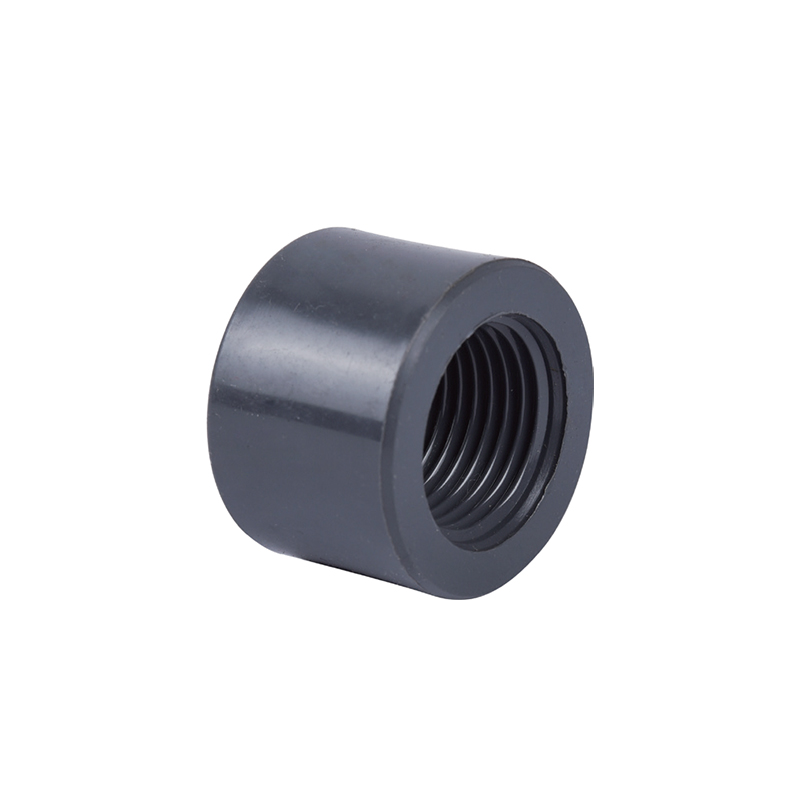
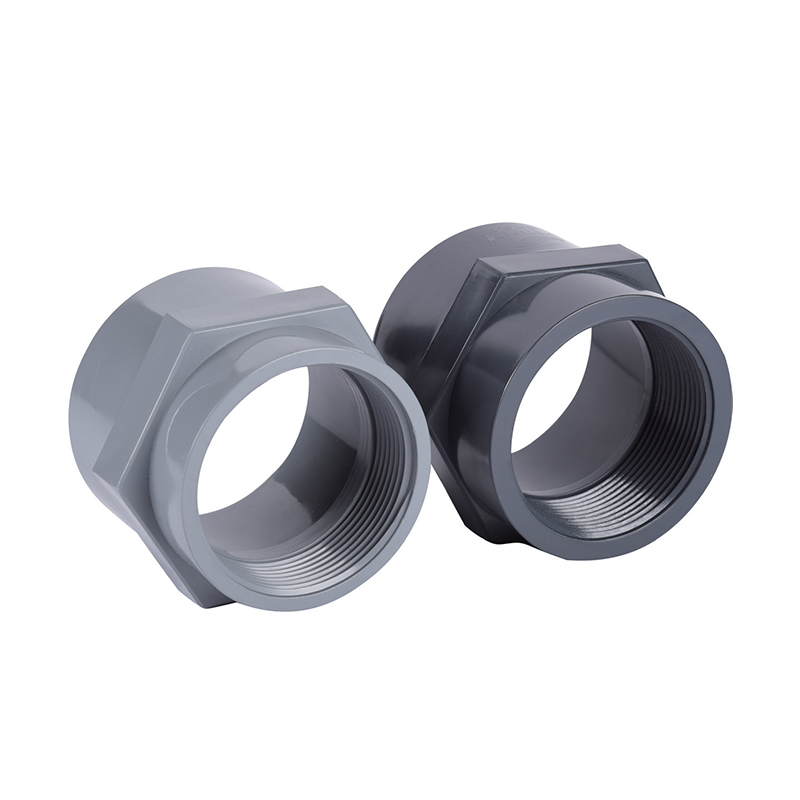 Custom SCH8O/DIN UPVC/CPVC Female Adapter For Food Industry/Automotive/ElectroniZheyi Pipeline (Wuhan) Co., Ltd. Is China Custom SCH8O/DIN UPVC/CPVC Female Adapter For Food Industry/Automotive/Electronic Suppliers, Fa...View Product →
Thread compatibility deserves a direct check. ANSI systems use NPT threads, while DIN-standard designs may use different thread forms and pitches. Mixing the two looks right until the joint leaks. Confirm the standard on the drawing before ordering fittings, especially on export projects.
Installation Details That Prevent Field Failures
Solvent-cement joint procedure
Use a CPVC-rated cement meeting ASTM F493, and use a primer where the cement manufacturer requires it or where temperatures are low. Deburr and clean the pipe end, apply cement to both the pipe exterior and the socket interior, then insert the pipe with a slight twisting motion and hold it in place for the time stated on the label. Do not pressure-test until the joint is fully cured; in most field conditions that means waiting 24 hours.
Threaded joint procedure
Use PTFE tape or a thread sealant compatible with chlorinated PVC. Do not overtighten: Schedule 80 CPVC can deform or develop stress cracks well below the torque that feels normal in a steel fitting. Hand-tight plus about one-quarter turn is the usual guideline for NPT sizes. When a threaded connection must leave the socket world at a female port, a factory-molded socket x male threaded CPVC adapter prevents the unsafe practice of cutting threads into pipe on site.
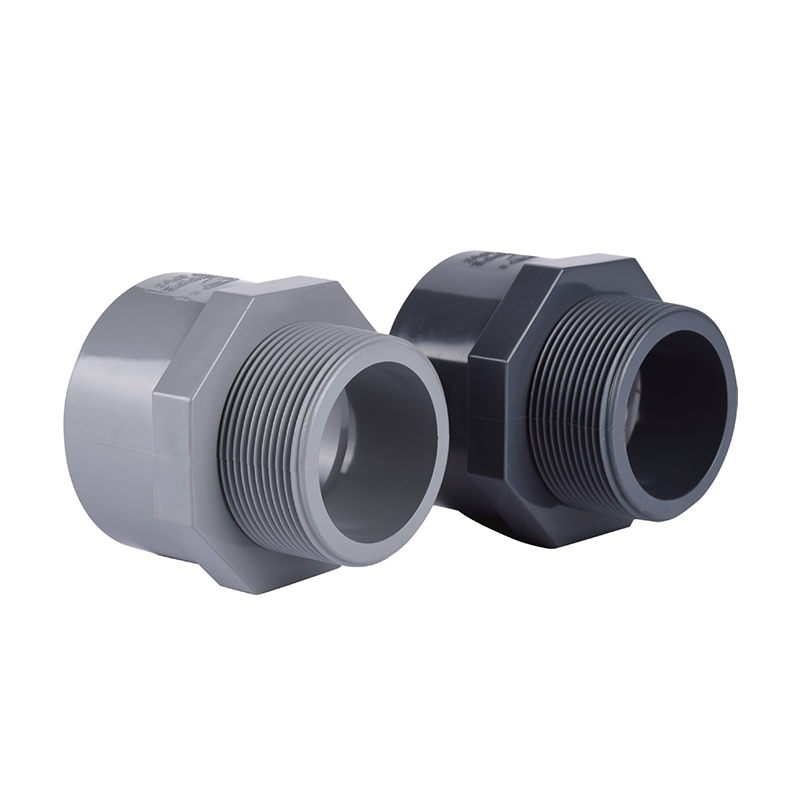 Custom SCH8O/DIN UPVC/CPVC Male Adapter For Food Industry/Automotive/Electronic Zheyi Pipeline (Wuhan) Co., Ltd. Is China Custom SCH8O/DIN UPVC/CPVC Male Adapter For Food Industry/Automotive/Electronic Suppliers, Fact...View Product →
Thermal movement and pipe support
Support spacing and anchor placement are part of joint reliability. Anchor the system at one end, guide it along the run, and let expansion legs absorb movement. Clamp the pipe with supports that do not pinch the wall, and never route hot CPVC lines where long threaded sections hang unsupported from a valve or instrument.
Sourcing Schedule 80 CPVC Fittings That Deliver on Spec
The socket-versus-threaded decision is theoretical if the fittings do not meet dimensional tolerances. Inconsistent socket depth means incomplete seating; inconsistent thread form means leaks that no sealant can fix. Buyers should verify the manufacturing standard, inspect socket dimensions and thread forms, and confirm the pressure rating at the system's actual service temperature. Because every rating in this discussion is temperature-dependent, review the temperature derating guidelines for UPVC and CPVC fittings before finalizing a bill of materials.
ZHEYI produces industrial CPVC and UPVC piping products to both ANSI and DIN dimensional standards, with ISO 9001-based process controls and factory-level dimensional checks. That is a practical advantage when the project specification changes between phases or when the same line is being quoted for export. The supplier's ability to hold socket depth, thread pitch, and wall thickness consistently across a batch is what turns a good material choice into a reliable installed system.
Socket, Threaded, or Both: Decide by Point of Use
There is no universal winner between threaded and socket Schedule 80 CPVC fittings. Socket joints give you the highest pressure capacity, a clean internal bore, and the lowest lifetime leak risk. Threaded joints give you access, speed, and easy equipment tie-ins at a measurable cost in pressure rating. The robust approach is to specify socket fusion for the high-pressure backbone of the line, reserve threaded connections for places that genuinely need to open, and use factory-molded socket-to-thread adapters at every transition. That combination keeps pressure ratings honest, installation crews productive, and the process line in service.
 +86-15258772971
 dinys009@163.com

 English
 한국어
 Español
 عربى